Southern Agrarianism and the culture of the Old South

Author: Stephen Clay McGehee (Page 7 of 14)

Born-Again Christian, Grandfather, husband, business owner, Southerner, aspiring Southern Gentleman. Publisher of The Southern Agrarian blog. President/Owner of Adjutant Workshop, Inc., Vice President - Gather The Fragments Bible Mission, Inc. (Sierra Leone, West Africa), Quartermaster and Webmaster - Military Order of The Stars and Bars, Kentucky Colonel.

Food Storage Wisdom

IMG_6492_640x480A generation or two ago, families had the good sense to always maintain a good food storage program because they understood that bad things can happen to food supplies. At some point, America became complacent and assumed that there would never be a time when we couldn’t get in the car, drive to the grocery store or restaurant, and find exactly what we wanted in bountiful quantities at cheap prices. That is not a good assumption. Now things are starting to return to a more sane idea that every family should have their own secure food storage plan. Food storage is still viewed as a somewhat quirky, semi-paranoid idea, but anyone reading The Southern Agrarian understands that it is a very wise move.

These are some notes compiled by a relative who spent forty days living entirely off of stored food supplies. I have known him for my entire life. He is a physician, and looks at this from a very analytical and physiological standpoint. I found myself modifying our family’s own food storage program after following his experience during those forty days.

  • CANNED GOODS—Canned goods have a limited shelf life and should not be part of a survival food program unless they are rotated as part of one’s regular eating. Older foods may not make a person sick, but they taste funny and stress the digestion.
  • FREEZE-DRIED FOODS—Freeze-dried foods have a very long shelf life and are quite palatable and satisfying, both the vegetables and the meats.
  • OILS—Oils are not sold as part of a survival package. They must be acquired separately. They are needed for cooking, palatability, and calories. Vegetable oils probably have important essential fatty acid nutrients, too.
  • NUTS—Easy to store, and a satisfying supplement to many foods.
  • GRAINS—RICE, RICE, RICE. Easy to prepare, easy to store, goes well with other foods. More palatable than freeze-dried potatoes, easier to prepare than breads. (If I had it to do over, I would have bought more rice and less wheat. THIS WAS ONE OF THE BIG LESSONS OF MY EXPERIENCE.)
  • LEGUMES—Easy to store, easy to cook, satisfying. (Legumes, along with rice, became the staples to which I added other things.)
  • SEASONINGS—Seasonings are critical to making legumes palatable. They are sold as packets in grocery stores next to the legumes (dried beans).
  • DIETARY SUPPLEMENTS—Fish oil caps, and hard-coat (i.e. oxygenation-resistant) vitamin pills. Just in case something is missing from the other foods.
  • BULK SUPPLEMENTS—Fiber supplements and perhaps mag citrate. Under survival conditions they can make it so you have one less thing to worry about.
  • PRESERVATION—Many foods come in large containers and once opened, unused portions are susceptible to spoilage unless properly stored. I use mason jars and evacuate air with a vacuum pump. (Completely filling the mason jar is another way to minimize the amount of oxygen in the jar, too.) Weevils can destroy grain supplies if grains are exposed to oxygen.
  • MISC—Salt; sugar; anything you use for cooking. Tincture of iodine, to make drinking water safe. (Think of other supplies.)
  • PRACTICE—If you are not experienced, you will neglect supplies that are important and overstock supplies that are unimportant.
  • PRESERVATION II—Light, heat, moisture, oxygen. To maximize shelf-life, keep these to a minimum.

MISCELLANEOUS LESSONS LEARNED:

  • Old canned goods may taste alright, but leave me feeling slightly queasy for hours.
  • Freeze-dried meats and vegetables can be sprinkled onto moist foods and eaten with no additional preparation. This is convenient, and they are more palatable dry than reconstituted.
  • Ketchup, mayonnaise, and salad dressings are wonderful for dressing up foods. They have limited shelf life, probably about a year, but they are so good and so familiar it is worth keeping a fresh supply.
  • Some freeze-dried fruits are more suitable than others. Raisins are substantial and flavorful, whereas strawberries and blueberries are puffed-up and acidic. The raisins would be more of a staple, and the other berries serve as part of a treat recipe.
  • Powdered milk can be sprinkled onto foods (like oatmeal) and taste quite good (add peanut butter and raisins, please) and avoid the nuisance of reconstituting to an insipid, fat-free drink that must be protected from spoilage.
  • Beverages will be limited. Coffee, tea, grog, crystallized drinks can be properly stored indefinitely. Liquid concentrates do not have indefinite shelf lives. I favor the fortified orange drink from my supplier.
  • #10 cans are much more convenient than 5-gallon pails, unless one has carefully thought out his usage patterns.
  • Lots and lots of mason jars will be needed in order to have opened a variety of foods without losing the balance to spoilage.
  • The moist, hot, recently prepared rice and legume combo made me feel like I was eating fresh, rather than off-the-shelf survival foods.
  • Many “combo-recipe packs” (e.g. beef stroganoff, spaghetti and meatballs, etc.) are very salty and should probably be “cut” with a bowl of rice.
  • Pan breads (pancakes, waffles, cornbread) are more practical than firing up an oven to cook loaves or biscuits. Under survival conditions, baked bread will become a luxury item.

Complex Societies vs. Southern Agrarianism

Southern Agrarianism encompasses many things – it has aspects of politics, literature, culture, and industry/agriculture. While it is not merely a nostalgia for simpler times, simplicity is a major part of it. The opposite of the simplicity of Southern Agrarianism is the complexity of the civilization that we now have.

In this brief video, Dr. Joseph Tainter explains the collapse of complex civilizations. Dr. Tainter is the author of The Collapse of Complex Societies. Following this brief video is a series of seven videos of a lecture that explain this in a very scholarly manner.


For a more thorough discussion by Dr. Tainter, see the following seven-part series of videos:

Part 1

Part 2

Part 3

Part 4

Part 5

Part 6

Part 7

Eat What You Grow

This Black Beauty eggplant is a reliable producer here in The South.

This Black Beauty eggplant is a reliable producer here in The South.


Most of us tend to plan our gardens, at some point, by leafing through a seed catalog and picking what we like to eat. While “Grow what you like” is certainly a good way to start, a more realistic plan is to “Like what you grow”.

I have heard it said that there are places where one can grow just about anything. Unfortunately, I have never lived in such a place, so the best plan for me is to find what grows well here and focus on that. Once I find what grows well here, the focus then shifts to finding ways to prepare it so that we enjoy eating it.

I was never really fond of eggplant, but in the hottest part of the summer, eggplant is one of the very few things that thrives in the heat. I have never had any problems growing eggplant. It seems to repel bugs and I’ve never seen any disease. Aside from very mild heat wilt in the hottest part of the day, the heat doesn’t bother it. In addition, it produces a lot of fruit with just a few plants. Another plant with similar characteristics is okra. Since that is what grows well here, our focus then shifted to finding ways to make the best use of those crops.

Laura always seems to find a way to prepare a meal that I am sure to love. With eggplant, she slices it into thin slices, coats it with flour, then dips it in egg, then in seasoned bread crumbs. She then fries it in a cast iron skillet (cast iron is a requirement for any Southern kitchen worthy of the name) until the outside is nice and crispy. Add a bit of coarse-ground sea salt and serve. It is delicious.

Okra is even simpler – she cuts it into sections, fries it in oil, then salt and serve. Fried and breaded okra is, of course, one of the classics, but this is such a simple and delicious way to prepare it that it has become our standard. For a bit of variety, try okra gumbo – the acid in the tomato cuts the “slime” that makes many folks turn away from okra.

The key here is to shift the focus from trying to grow “favorites” that don’t do well where you are, to finding ways to really enjoy what does grow well at your location. Our next experiment will be Seminole Pumpkin – a staple of the early Seminole Indians here in Florida.

More Information on the Simple Pump

In May of last year, I wrote a post (see original post) about the installation of a hand pump in tandem with the electric pump that supplies our household water. The folks from Simple Pump learned of the post, and pointed our some incorrect information in that post concerning their product. I invited them to provide corrected information and to describe the Simple Pump and its benefits. I deeply appreciate the opportunity to correct any wrong information concerning hand pumps – or anything else covered on The Southern Agrarian.


Mr. McGehee,

I’d like to offer you some information about the Simple Pump.

It’s clear that you did not meet a “Simple Pump system”, as we do not use any lightweight plastic pipes. Our drop pipes are Sch.120 PVC, manufactured specially for us with bell-end, screw-in joints that are much stronger than PVC’s normal glued joints. The company you spoke of was not an authorized Simple Pump dealer, and I can only conclude they put together some Simple Pump parts with other components. (We have found out about a few instances of this happening. It seems you have shown us another.)

Following are some particular points about the Simple Pump.

With respect to these points — what advantages the Simple Pump has are only in respect to a particular person’s needs and perspective. E.g. A GM truck or a Ferrari have NO advantage at all over a Ford Focus — except with respect to what a particular individual wants or needs.

Do they need to pump from a shallow or a deep well? Are they looking for something lightweight (and less expensive) to pump for a couple of hours or days? Or do they want to have backup they can depend on for weeks, months or longer?

As in any field, it’s a question of each person balancing needs and cost with capabilities, durability and usability.

Simple-Pump

ABOUT THE SUCKER RODS

The fiberglass rod is 20,000 lb tensile strength, enormously stronger than necessary, even to pump from a water level of 325 feet.

SIMPLE PUMP’S EASE OF USE

Steel rods provide strength, at the cost of much greater weight and, therefore, pumping effort — to the extent that it can be prohibitive for the average person at even a moderate depth. And when we get a little further down, various other pumps rapidly become unusable. E.g. at 200 feet, some other pumps require forty of fifty pounds of downforce on the handle. The Simple Pump requires TEN pounds.

One person’s remark:
“…lifting water from 50-75 feet, and my 6-year-old was doing it with ONE HAND!!!”

The lower pumping effort also allows the Simple Pump to pump from much further down than any other hand pump — from 325 feet water level. Even then, the effort remains moderate – only about 16 pounds.

QUALITY

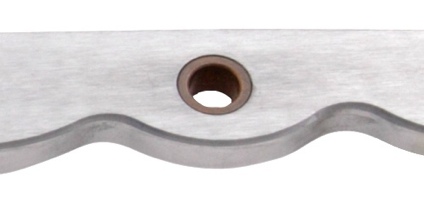
Here is just one illustrative point about the Simple Pump. The pivot points of the handle are not just drilled holes with bolts through them. They have bronze bushings — a very tough metal. And not only that, the bronze is then impregnated with graphite to lubricate. There are many other details where the quality of manufacture is evident.
bushing

Some comments:

“This is obviously the Cadillac of the industry, and I am impressed. I recognize the value of the investment in your quality.”

“These parts look like they belong in an Indy Car engine.”

“We love the pump and know it will give us many years of quality service. As a mechanical engineer myself in aerospace, I know quality when I see it – and this is the real deal.”

TEN QUESTIONS TO ASK

Of course, there is much more I could write about. I hope these few points, above, have given you a better impression of the quality of the Simple Pump. I would invite you and your readers to examine the Simple Pump and other pumps, with these questions:

1. What is the weight of the mechanism? Can I install and maintain it myself?

2. Is the pump freeze-proof?

3. Is the pump designed to share a casing with a submersible? Or must it be installed in a dedicated well?

4. What are the high-wear pivot points made of?

5. How deep can water realistically be pumped from?

6. How much pumping effort from, say, 100 foot static?

7. Does it pump into my home’s pressure tank, giving full use of all taps and fixtures? Or just pump into a bucket?

8. What is the material of the foot valve seal? What is the expected replacement frequency? At what cost and effort?

9. What is the full cost, with shipping, of a ready-to-go system?

10. Is there a written warranty?

Regards,
Michael Linehan
SIMPLE PUMP COMPANY
www.simplepump.com


I need to point out an important factor that we haven’t covered yet, and that is the matter of volume per pump stroke. The first hand pump well that I put in (see photo below) had a 3″ pump cylinder. Each stroke would pump a large amount of water, but it was very difficult to pump. Young children could literally swing from the pump handle; it was that hard to pump. The Bison pump has a smaller diameter cylinder and can easily be pumped with one hand – but it pumps less water per stroke than the 3″ cylinder did. The Simple Pump is even easier to pump than the Bison, but with it’s 1″ pump cylinder, it pumps even less water per stroke than the Bison. The bottom line here is that the basic rules of physics apply – you don’t get something for nothing. Lots of water = lots of work, no matter how you slice it.

• You can pump it fast
• You can pump it easy
• You can pump lots of water
Pick any two. You lose the third one.

Look at your own needs, decide what works best for YOUR SITUATION, then find what best fits those needs. If very easy pumping is a big factor, and you don’t mind pumping more strokes for the same amount of water, then the Simple Pump is clearly the better choice. If the amount of effort per stroke is not a major issue for you and you’d rather pump more water with fewer (but harder) strokes, then the Bison or a traditional hand pump may be your best choice. There is no single “Best Choice” for everyone.

Bison water pump installed in tandem with an electric submersible pump on a 4 inch well

Bison water pump installed in tandem with an electric submersible pump on a 4 inch well

Traditional hand pump. This started out with a 3" pump cylinder, but I replaced it with a smaller Bison cylinder.

Traditional hand pump. This started out with a 3″ pump cylinder, but I replaced it with a smaller Bison cylinder.

Chicken Water Systems

I have tried just about every common method of supplying chickens with clean drinking water. I now have a box full of “tried it” watering systems, plus more stacked in the attic. Here are some of the things I have learned:

  • Water quality matters. If you have high mineral content in your water, your choices are limited.
  • Chickens will mess up anything they can touch. The ability of a water system to minimize that is important.
  • Water is heavy. You don’t want to have to carry a full container of water in order to resupply your chickens – at least not as a regular routine.

Each water system has its own advantages and disadvantages, so you can’t really say any one system is the best. I have found what is clearly the best choice for my situation, but yours may be quite different. We’ll start with what I have tried and found lacking.

Container Water Systems

These are anything that includes a container that must be manually refilled. They are great for temporary use when you just can’t run a pressurized water line. Water is heavy though, so you don’t want to plan on that as the norm.

You might think that bigger is better since you don’t have to fill it as often. I have container systems from 5 gallons to quart jar systems.

  • The 5 gallon systems should just be crossed off the list. They are just too heavy to work with, and they get dirty and have to be cleaned before they are empty.
  • The quart jar systems are great for chicks that can’t handle other systems. I have both plastic and all-glass systems. For the purpose for which they were designed, they do a great job.
  • The 1-gallion plastic systems are a good choice for a temporary arrangement. One gallon isn’t too heavy to put into position in a cage, and it lasts about long enough that it’s time to clean it when it’s time to fill it.

Weight Regulated Systems

These systems depend on the weight of water in a bowl to keep the bowl filled. There is a fairly sensitive calibration that has to be done to get it right. Too much in one direction, and the bowl will overflow. Too much in the other direction and it will empty without being refilled. These systems use the same valve system as an ordinary tire valve. In fact, the replacement valve stems are the same as you would get in an auto-parts store.

The problem with these systems is the rather delicate valve that controls it. If you have good, mineral-free water, then it should work just fine. I don’t have that, so the valve tends to get encrusted with mineral deposits and it stops working. Unfortunately, it isn’t just the replaceable valve stem that gets ruined, but the housing also. For my water, they are more trouble than they are worth. Again, if you have good mineral-free water, these may be an excellent choice.

Float Controlled Systems

These are basically water bowls with a float valve similar to the way that a toilet tank works. It maintains the water level by means of a float the opens the valve when the water level gets below a certain point. There are two disadvantages I have seen with these:

  • They have a rather large bowl area, which means lots of area for the chickens to mess up the water.
  • They tend to be a bit sensitive to the water pressure. If you supply a consistent pressure of the right amount, this is not a problem. Just make sure you have the supply working correctly.
  • The ones I have used have been cheaply made. The molded plastic floats develop leaks and stop working. The styrofoam floats have poor quality valves. That is a real deal-killer for me. The low quality that I have seen ( and I have tried several different brands) has led to me crossing these off my list.

 Drinking Cup Systems

These systems use a low pressure water supply that keeps just a tiny amount of water in the bottom of a drinking cup. The chickens activate a small plastic valve when they try to drink from the very bottom of the cup, and that adds a bit more water into the cup. Here are the reasons why I like this design best:

  • It is the cleanest system that I have found. The tiny amount of water means that there is much less opportunity for the chickens to mess up the water. There just isn’t much there for them to mess up.
  • The construction is all plastic, except for a coil spring. Despite the high mineral content in our water, these cups just keep on working.
  • The only problems I have had is with the water lines leading to the water cups. Make sure that you use black connectors with your tubing. A white connector allows enough light through so that algae can build up in that spot and gradually clog up the water line. If you have to use white connectors, add a bit of black electricians tape to block the light, and that should take care of the problem.
  • They are easy to add and move. I keep a spare line with a kink in it available so that if I need to separate a chicken, I can snap a water cup in a cage and connect that water line to it.


A few other related notes:

  • Chickens are unable to swallow. Notice that when they drink, they must raise their head to let the water drain down their throat. Their food works the same way. That means that when they eat and then drink, some of that food can drop into the water that they are trying to drink. It’s best not to have their water too close to the food. A little distance is a good thing.
  • Producing eggs takes a lot of water. Never let your chickens run out of water. If you see them flying over fences and other abnormal behavior to get out of their normal space, they might just be looking for water (don’t ask me how I know).
  • See also: A Water Tower for the Chickens.
  • See also: Clean Water for Chickens.

The Six Item Grocery List

NewberryHouse_IMG_3176_rs
This past Saturday, our family had our 58th annual family reunion. The last remaining member of “The First Generation” (my father’s siblings) is my Aunt Evelyn. One thing she mentioned really caught my attention. She said that there were only six things that her mother bought from the grocery store:

  • Sugar
  • Flour
  • Salt
  • Pepper
  • Coffee
  • Rice

Everything else needed to sustain their family of mother, father, and ten children came from their farm in Newberry, Florida.

A Predator Problem We Don’t Have In The South

I’ve mentioned previously that we work with Bible missionaries stationed in Sierra Leone, West Africa. We received these photos this afternoon. They were taken last night when they found this five foot long cobra in their chicken coop.

cobra-DSC_8110cropped
cobra-DSC_8112cropped

As much as I don’t like having to deal with raccoons and possums and the occasional fox, I’ll take them any day over having to deal with cobras.

Here is what happened in the words of Mrs. Laura Holt, who took these photos:

Last night around 9:00, Stephen and I were enjoying the cool evening air on the veranda when I heard a ripple of distress pass through the chickens. I know the voice of my flock and was certain I knew what the problem was. Stephen and I grabbed flash lights and sure enough, there it was – a five-foot cobra! In recent months we have lost 4 hens to snake bites so we didn’t want to let this one get away.

While I ran to get two shovels, a machete and the camera, Stephen was able to keep the beast fairly well corralled with the flash light – they hate light so he kept it going in circles by strategically shining the beam of light in its eyes. At one point it tried to climb a tree just outside the poultry yard but with no branches low enough it was unsuccessful though it did reach a height of about 5 feet. It finally curled into a tight ball at the base of the tree.

While holding the flash light in his mouth Stephen dealt a hard blow to the back of the beast with the shovel. Despite its serious wound it still had strength enough to climb the gate to the chicken yard all the while spitting venom and emitting a low but evil sounding hiss and a growl-like sound; very creepy. Stephen then pinned it to the gate with the two shovels but it managed to slip out and went to the ground. With the snake thus weakened he then took the machete and severed its head.

All the while Mercy was a valiant assistant. At one point he did bite the snake though we tried to keep him back as best we could. But his maneuvers were a helpful distraction to the snake so Stephen was able to get a very clear shot at the base of the head. Mercy hates snakes and has a natural sense that they need to die. He has killed a few but they were not poisonous. He even has a special bark he uses only when a snake is present and I always take that alert seriously. I dread the day when he tries to face one of these deadly foes on his own. When I was doing my morning chores today I found one hen who had fallen victim to the snake.

Tomato With Your Oil Change?

IMG_3879
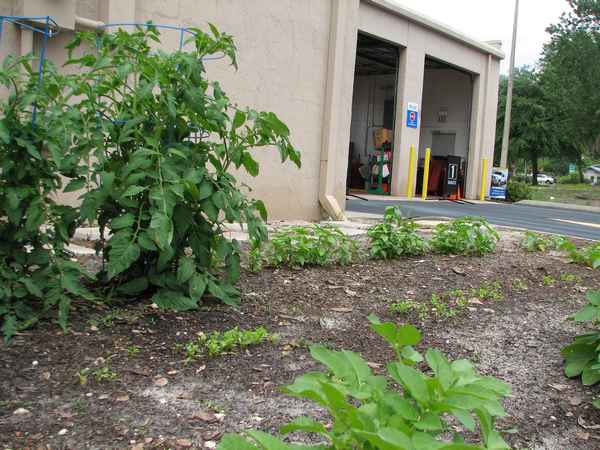
I’ve been taking my vehicles to Classic Lube in DeLand since the early 1990’s. When you find a place you like, you stick with it. Last week, after finishing our oil change, the guys asked if we would like to see their garden. Of course, we said, “Yes”.

They took us back behind the building to an area where a utility pipe comes up and where there used to be some of the usual landscape plants that most businesses have. There, instead of the usual sterile and unproductive living decorations, we saw a garden planted with tomatoes, radishes, onions, basil, lettuce, cilantro, and probably others that I can’t recall at the moment. The dirt that was originally there was replaced with some good top soil. They tend the garden during the normal down time that any business has during the day – and they have fresh vegetables for their lunch

Wouldn’t it be great if other businesses followed the lead of Classic Lube and helped make their communities just a bit more resilient and self-contained?

In addition to the photos, we left with a fresh radish.

IMG_3878

IMG_3881

IMG_3882

A Wash Station for the Garden

IMG_3883

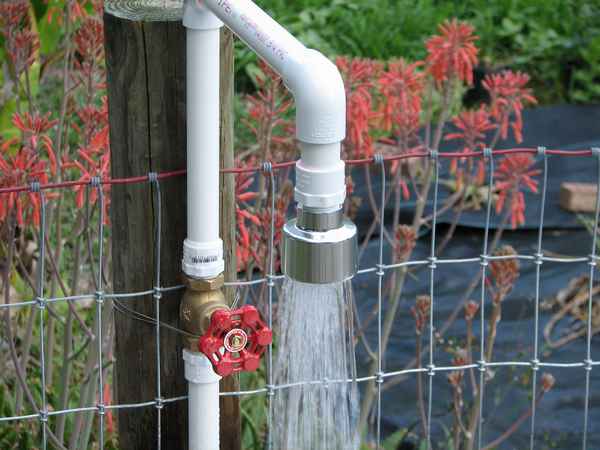
I have wanted a place to wash vegetables and eggs without bringing dirt into the house and without having to stoop near a water spigot or juggle a garden hose. When my brother came across a scrapped stainless steel hospital cart, I had found what I was looking for. I cut the bottom part of it off to bring it down to a comfortable working level.

It is setting on blocks that are arranged so that it tilts back and to the left to control drainage. A section of PVC pipe was cut to form a gutter that drains the water off into the garden. I used 1 1/4″ PVC, but I may rebuild that part and use a larger diameter pipe for the gutter and drain. It works well for the flow of water that I would normally use, but if the valve is opened for a greater flow, it is more than that pipe can drain away and it starts splattering on the ground rather than going into the garden.

Below the working surface, a standard hose bib is available if needed.

Below the working surface, a standard hose bib is available if needed.

The water comes out of the "shower head" removed from a "water wand" from the hardware store.

The water comes out of the “shower head” removed from a “water wand” from the hardware store.

Stainless steel wire is used to secure the valve to the fence post.

Stainless steel wire is used to secure the valve to the fence post.

The WaterBuck Pump

waterbuck-pic
We’ve covered manually-operated water pumps several times previously, and for good reason: without a dependable source of water, nothing lives – including you and your family. You can’t have a self-reliant homestead without an absolutely reliable source of water. For some folks that may mean a sweet, clear spring; it may mean a nearby stream and a good filtration system; it may mean a cistern with an efficient rain collection system. For most of us though, the best choice is having our own well with a non-electric pump.

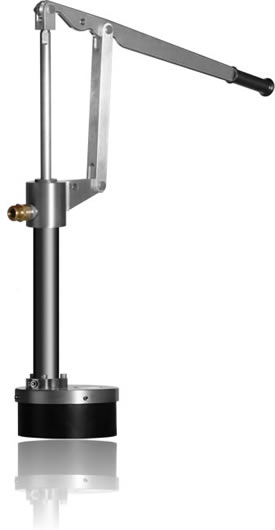
The WaterBuck Pump is a pump unlike anything you’ve ever seen before. It doesn’t look like your grandparents’ hand pump, and it doesn’t pump like it either. When you need to pump the quantity of water that it takes to water a large garden, supply livestock, and keep your home and family supplied with lots of pure fresh water, it’s hard to imagine anything better than the WaterBuck Pump, except for maybe a windmill if you have a site suitable for one. Is it the best choice for every situation? No, of course not – but then neither is any other method of pumping water. I am very pleased with our Bison stainless steel water pump and our Dempster cast iron pump, and have no plans to ever replace them. Every situation is different and has different requirements. The WaterBuck fills a need that simply had not been effectively met before its introduction, as far as I can tell.

I have never actually seen the WaterBuck Pump, so this is not a product review – only an introduction to a new product that may be of interest to Southern homesteaders. Now that we’ve gotten that out of the way, let’s look at the WaterBuck Pump. First of all, it is massive – 370 pounds. On one end of the scale are the medium-term water pump solutions made of PVC pipe glued together along with some metal bolts and fasteners. The WaterBuck is on the opposite end of the scale – or even off the scale.

A major factor in reliability is ease of maintenance and ease of repair should that ever be needed. I asked Darren (the developer of the WaterBuck Pump) about this: “Simple maintenance consists of greasing bearings and lubricating chain. The mechanics of my machine are much different than that used for windmills and common hand pumps. The machine has four points of mechanical advantage for ease of operation and maximum discharge. These are light, medium, heavy and heavy duty.”

Although the WaterBuck Pump is a brand new product, the developer of the pump is no newcomer to applying technology to muscle power. Their first product was the WaterBoy Well Bucket. Another unique product is their Pedal Powered PTO, scheduled for release at the end of May, 2013.

You can find more information about the WaterBuck Pump on their website.

« Older posts Newer posts »