The Southern Agrarian

Southern Agrarianism and the culture of the Old South

Page 13 of 14

Fried Okra

One of the very few things that will grow even during the hottest part of the summer is okra. It not only grows, it thrives. Once it starts producing, picking okra is literally a daily task. Okra must be picked before it gets too big. Large okra pods quickly toughen up into a woody texture. The trick is to pick them when they’re about the length of your longest finger – at least that’s how I do it.

Okra can be prepared in a number of ways, but unless you’re part of a very small percentage of people who enjoy a slimy texture, the key is to get rid of the “slime” that okra is well known for. My two favorite ways are fried and in a gumbo with tomatoes. The acid in the tomato cuts the “slime”, and frying also eliminates it. We’ll talk about okra gumbo another time. This post is about fried okra.

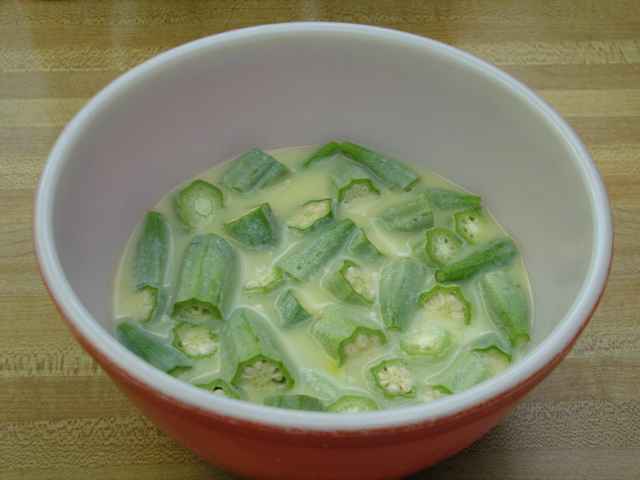
Fried okra is almost like eating popcorn or potato chips – you can just keep on eating them until you’re full. One tip that I learned is that, after cutting it up, you want to let it soak for a couple of hours in milk with an egg mixed in. That lets it work its way down through the slices.


Okra pods, sliced and soaking in milk and egg.

In the batter

With the milk and egg serving as a glue, build up a good heavy layer of batter.

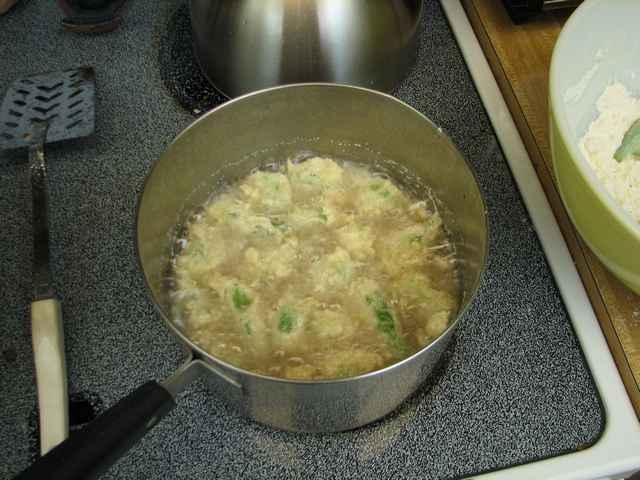
Deep fry in oil until the batter turns a golden brown.

At the bottom, fried okra. At the top, eggplant cooked the same way.

Lessons Learned – Part 1

I’m titling this one “Part 1”, not because I have a “Part 2” in mind, but because learning new things is an on-going process. I’ll write “Part 2” (and 3, and 4, and …) as soon as I have more lessons learned that I want to record.

More Plant Spacing – I have been planting too closely for most plants. By the time the plants mature, they are so densely packed together that the inner leaves do not get sufficient light, so they just yellow and die. There is not enough air circulation to dry the inner parts of the plants, and though I can’t prove it, I suspect that the plants would be healthier with more room to “breathe”.

Use Plant Cages – Primarily for tomatoes, but also for plants like peppers, some way to stabilize and contain the plants is a major advantage. Some of the tomato plants have grown over the sides of the garden and down to the ground. When they grow that big, they are much more difficult to work with, and much more susceptible to broken branches and other damage. We haven’t had any high winds yet, but plant cages will keep the plants from being blown over by the wind.

Prune Where Needed – The tomatoes ended up putting too much energy into growing branches and leaves rather than in growing fruit. Although pruning tomatoes is more commonly done in the northern parts of the country, I will be pruning my next crop of tomatoes. This is also related to using tomato cages to contain and train the plants.

Upon doing some more reading, it looks like this year’s poor blackberry crop may be due (in part) to not having done any pruning on them. I’ll do that next season. I also neglected to give them the fertilizer and water that they should have gotten.

Grow Up – Not Out – I had planned to use bush beans and determinate variety tomatoes and plant in stages, thinking that I would then get enough beans in a single flush to be able to can the surplus. Somehow, that just didn’t work out as planned. I’ll be going back to pole beans and indeterminate tomato varieties so the harvest is spread out over the life of the plant rather than one large flush of produce and then the plant dies. This also allows for better utilization of the available area in the garden. The various trellis designs that I have been experimenting with look very promising.

Better Planning – I have been pretty much planting wherever there was an empty space in the garden. That kind of haphazard planting just doesn’t work very well in the long term. I will be dividing the garden into 4 sections, and making sure that crops are rotated so that it will be 4 years before a section contains the same type of plant. That should help reduce soil-borne disease and balance out the nutrients in the soil.

Earlier starting – I did fairly well this year, but I still want to start my seeds for the Spring garden around the end of December or first of January. In this part of the country, with the seedling setup that I have, that should work out just fine. There may be some risk of a late frost, but the plants can be covered if needed. I usually try to have at least twice as many seedlings as I plan to use in case of a problem like that. If they aren’t needed, there are plenty of folks eager to take them.

Color Makes a Difference – This year, we planted both yellow squash and zucchini. Both grow about the same, both taste about the same, but both look very different. I discovered that the dark green zucchini is very easy to overlook among the dark green plant. Several times, I have discovered huge zucchinis that are far bigger than I wanted (although they do quite well when baked). They got that way because I overlooked them. Next year, we might be growing yellow squash and not zucchini, we’ll think that over carefully before planting. The bright yellow squash stands out and is a lot easier to see when it’s time to pick them.

Mix it up – I have noticed some differences in the sections of the garden that I can only attribute to not having mixed the growing mixture up well enough. When the hot weather garden is finished, I will be adding some more compost and doing a better job of mixing it up. Just to make sure though, I’ll be doing some soil testing.

Clean Water for Chickens

Chickens seem to prefer drinking the nastiest water they can find. It is our job to make sure they only have fresh clean water. From my own reading, experience, and talking with others, the best way to do this (unless you are supplying them directly from your own drinking water) is to add hydrogen peroxide to the water tank. Hydrogen Peroxide (H2O2) is a powerful oxidizer that kills (literally by burning) any organic matter in the water. Keep in mind that, ideally, by the time the water gets to the chickens, the hydrogen peroxide will have broken down into water by releasing the extra atom of Oxygen. Our objective is to have clean water – and only clean water – for the chickens. We aren’t trying to feed them hydrogen peroxide.

When using hydrogen peroxide, it is extremely important that it be properly diluted – contact with high concentrations can be quite dangerous, and if it is too low, it will be less than effective. When handling concentrated hydrogen peroxide, you need to be very careful – eye protection and rubber gloves would be a good idea.

The 35% food grade hydrogen peroxide can be found at most health food stores. It needs to be kept refrigerated and away from light. Again, read the warnings and handling instructions carefully.

The recommended concentration is 8 ounces of 35% food grade hydrogen peroxide per 1,000 gallons of water. For my 35 gallon tank, I use 1 1/2 teaspoons in 30 gallons of water (I don’t fill the tank all the way to the top). I have since switched to a metric graduated cylinder to measure, so that comes out to 7.097 ml of 35% food grade hydrogen peroxide.

Resources:
Hydrogen Peroxide in Agriculture
Water line cleaners
A Secret Ingredient for your Water Trough

An Interesting Chicken Tractor Design

The Little Egg Chicken Tractor from Gardner's Supply Company

I am fascinated by chicken coop designs. Gardener’s Supply Company has something called the Little Egg Chicken Tractor. Now, I tend to be very much a do-it-yourself type, so I see something like this and think about how I could make it better (and cheaper), so it’s the basic design that I’m looking at.

It looks like they are using parts used for chain link fencing as the framework for the run. I have used those same parts to build a hawk-proof top for the “chicken nursery” where my chicks stay until they are fully grown and able to fend for themselves in the main chicken yard. It looks like it should be a very sturdy and lightweight design. My previous attempts at something like this proved to be far too heavy to be practical to move. This looks like it would work just fine.

The description says it will hold two to four chickens. I’d say that two large hens, such as Rhode Island Reds or Buff Orpingtons would be about right. It should hold four bantams just fine also, but I have found that bantams do a lot more scratching than larger hens do, so I’m afraid that they would do more damage to the ground than I’d want to see in a grass yard. For a suburban family wanting eggs a couple times a week, this just might be what they’re looking for.

One change that I would make is to change the angles on the bottom rail of the run so that when it is sitting on the ground, there is not a gap on the end where it joins to the coop. Just a little bend in the pipes should do the trick. That’s really just a minor issue though, since the ground isn’t going to be completely level, and as long as you’re moving it around regularly, they aren’t going to have time to scratch around and dig under it.

The fact that the wheels are where all the weight is would make it easy to move around. Overall, it just looks like an excellent design. I’ll have to build something like that myself and see how it comes out. If you don’t have the time or the inclination to build it yourself, you can get the whole thing directly from Gardener’s Supply Company.

ECHO Demonstration Farm

We recently visited the ECHO Demonstration Farm in Fort Myers, Florida. ECHO (Educational Concerns for Hunger Organization) is a great resource for those wanting to learn how to grow food in difficult conditions. This trip was focused on a missionary project in Sierra Leone, West Africa. I am vice-president of Gather The Fragments Bible Mission Church, Inc. – my wife and I provide logistical support for missionaries working to spread the Gospel of Jesus Christ in a remote part of a very remote country – Sierra Leone. This trip to ECHO was with one of those missionaries so that she could learn more about how to improve the agriculture in that area.

ECHO publishes some excellent books. “Amaranth to Zai Holes – Ideas for Growing Food Under Difficult Conditions” is one of my favorites. While it covers problems that we in The South usually don’t face (iguanas, elephants, and monkeys are not typical garden pests here in The South), it is filled with great ideas that we can use here.


Guide describing the "urban garden" area. The farm is divided into different environments, and the urban garden area is build on a concrete slab.

The chickens coop in the back supplies manure, which is made into a tea, which is drip irrigated on the plants.

Wooden pallets used to build a platform that holds plastic bags of soil for plants to grow in.

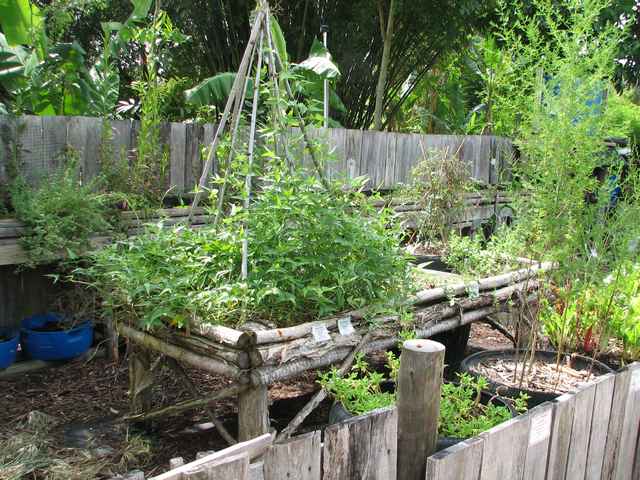
Poles forming a pyramid for plants to climb on.

Extremely shallow planting. A plastic pool liner was used, along with a piece of old carpeting to grow crops in. Hay and other materials provide shade for the roots and reduce evaporation.

More shallow garden experiments. All of these are right on top of a concrete slab.

Plants growing in concrete blocks.

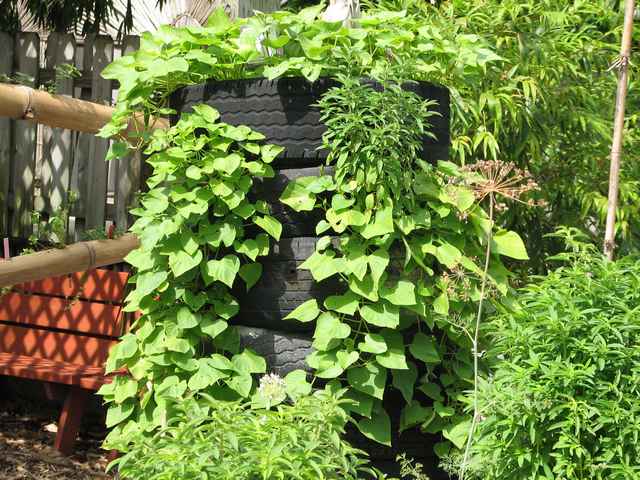
Sweet potatoes being grown in a stack of old tires filled with soil.

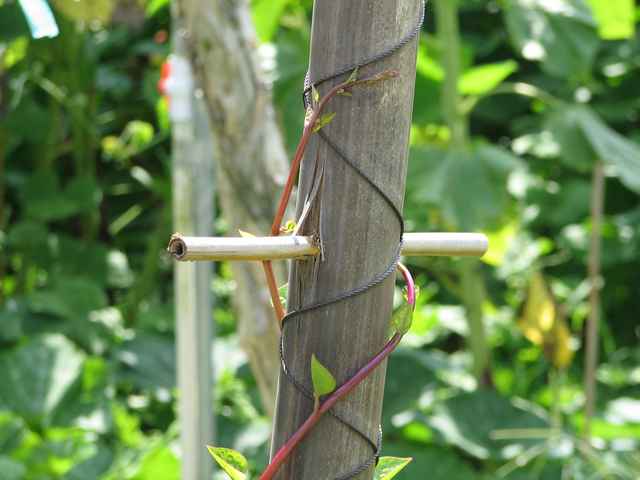
Tall poles (about 12' tall) were used to support climbing plants such as pole beans and cucumbers. The cord wrapped around gives the plants something to hold onto. The poles were supported with guy wires.

Biogas generator. This system uses manure to generate, capture, and store methane gas. The gas is stored in a truck inner tube. It is used to run a stove and lantern in this arrangement.

This is a dug well that has two pumps in it. The one being demonstrated here uses a hand crank that pulls pistons on a rope through a PVC pipe to pump the water.

This is a treadle powered pump that supplies the garden area to the left.

Huge sunflowers being grown here. These are the "Mammoth" variety.

Rice paddy demonstration. This is the traditional flood technique. Part of the reason this technique is used is to raise eels that are a delicacy in some parts of the world.

This is a newer, more efficient method of growing rice. The fields are not flooded, and other crops are planted between rice crops.

These ducks are part of a food producing ecosystem that includes micro-organisms that feed on the duck manure, and tilapia that feeds on organisms a bit higher on the food chain. The end result is meat from the fish, and eggs and meat from the ducks.

Plants being readied for their place at the ECHO farm.

A Water Tower for the Chickens

One of the earliest lessons that anyone learns when they start keeping chickens is that water is heavy. Lugging around gallons of water for the chickens is not a fun thing to do, and the older we get, the clearer that lesson becomes. The solution is to have the water piped directly to the chickens.

I have tried just about every possible method of delivering water to my chickens, so I now have a box filled with waterers that I no longer use. Someone who uses city water has more possibilities, but our well water has so much mineral content that anything that uses a regulator or metal valves will last only months before it is completely useless.

In order to get a consistent supply of low pressure water, I decided that a gravity feed system is what I need. I also wanted a system that keeps the water as clean as possible and has enough pressure and volume to supply water to several places – not just a single chicken coop.

The tower was mostly built on its side. Having a flat concrete slab to work on helped keep things relatively square.
The parts were clamped into place, then pilot holes were drilled. The tower was assembled with stainless steel lag bolts.

With the main frame of the tower completed, we moved it into place near the chickens. We made sure it was far enough away from trees so it wouldn't be damaged by falling branches during a storm.

The valve section is just slip-fit into the pipe so that it can be removed if needed. The bronze water spigot is where a hose is connected using a double-female connector to pump water into the tank.

The tank is a 35 gallon sprayer tank from Tractor Supply. It turned out to be perfect for the project.

The main water line is buried with screw plugs placed every 10' (indicated by the posts of the chain link fence just a few feet back). This gives flexibility in where chicken coops are located in the future.

The end of the main water pipe has a stub so that more can be added to the end by cutting and adding a coupling. Since this photo was taken, I have replaced the end cap with a gate valve. When it is time to fill the tank, I open the valve to flush out the main supply line and empty the tank before refilling it.

View showing the roof and two sides. At this point, the back and the front door have not yet been added. The roof is hinged at the back and slopes toward the front. (If it sloped to the back, it would be pouring onto the 'chicken nursery' behind it.)

To get more use from the tower, cattle panels were attached to the sides, and pole beans and cucumbers were planted around the sides and front.

The cattle panel trellis was attached to the top 2x4 using stainless steel wire.

The completed tower, fully enclosed. It is important to keep the sun off of the tank to keep the water cool and to discourage the growth of algae in the tank.

When filling the tank, the front door is propped open with a stick.

A Trellis For The Garden

Overall view showing how it fits into the raised bed garden. Blue Lake Pole Beans were planted along the trellis this afternoon.

This end view shows how the sides extend out past the edges of the garden. Also shown - in the foreground are bell peppers, the empty space beyond the trellis has newly-planted sweet potatoes, and beyond that is eggplant and squash.

A raised bed garden such as ours can present some added challenges when it comes to accommodating climbing plants. Once a trellis is filled, then it can really catch the wind, so having a structurally stable design is important. It also needs to be light enough to be able to move around easily. I had thought about having trellis capabilities built into the basic concrete structure but decided against it.

This trellis is 6′ wide at the top, while the inside dimension of the garden is 4′. This gives me the ability to simply reach straight up to pick the beans (or cucumbers or whatever I’m growing). Another benefit is that I could use an entire cattle panel (the standard size is 16′ long) without having to cut anything on it; if the sides had been straight, the top edge would have been another foot higher. I am 6’6″ tall, but there are still limits to how high I want to reach to pick vegetables.

Bending the heavy wire of a cattle panel is not easy. I bolted a fence stretcher to it so that I would have something to bend it around. It turned out to be easier than I thought it would to bend. Not easy – just easier. The cross braces are pressure-treated 2×2 with notches cut to hold the wire (I made two saw cuts and then used a wood chisel to remove the excess). They are secured with stainless steel wire wrapped and twisted. Before final assembly, I used cable ties to make sure it would work and the dimensions were right.

A fence stretcher was used to help bend the heavy wire

First Fruits – 2011

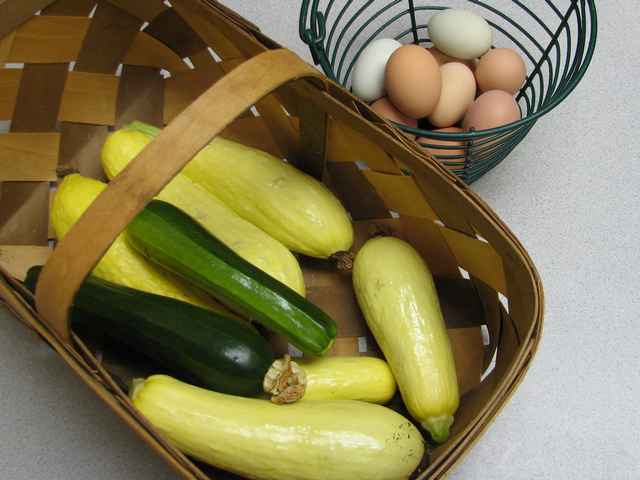
This evening, we had fresh squash and zucchini from the garden. The first of the beans are ready to pick, and the tomatoes should be ready soon.

Squash from the garden, and 11 eggs from the hens. What a great way to live!

Tomato plants overflowing - this is a group of 4 plants, with zucchini to the left and beans to the right. Photo taken on 05/19/2011

Squash - 05/19/2011

Tomatoes - It won't be long... 05/19/2011

Smell The Roses

While our focus is on the vegetable garden and chickens, we try to keep things in perspective. God created roses and other things of beauty for a reason. They are for us to enjoy and to reflect on the great God who created them – and us.

« Older posts Newer posts »