Southern Agrarianism and the culture of the Old South

Author: Stephen Clay McGehee (Page 10 of 14)

Born-Again Christian, Grandfather, husband, business owner, Southerner, aspiring Southern Gentleman. Publisher of The Southern Agrarian blog. President/Owner of Adjutant Workshop, Inc., Vice President - Gather The Fragments Bible Mission, Inc. (Sierra Leone, West Africa), Quartermaster and Webmaster - Military Order of The Stars and Bars, Kentucky Colonel.

Hoop Frames

Hoop frames are a great way to support any kind of covering over a garden. They can be used for a cold frame to protect from frost damage, with netting to prevent damage by birds and squirrels and rabbits, and even to prevent insect damage. Hoop frames can be made in various sizes, from small covers for a 4′ wide raised-bed garden, to a full sized greenhouse. In this post, we’ll be making small frames for the raised bed garden. The material will be half-inch EMT (Electrical Metallic Tubing), commonly known as metal conduit.

The trick to bending hoop frames is having the right tool for the job – in this case, we’ll be building a jig designed for the job. Without a bending jig, you end up with kinked pipe and uneven bends. Aesthetics play a big role in enjoying your garden. Make sure that what goes into the garden is neat and attractive looking.

This jig was built using mostly scraps. The plywood was a badly warped piece that probably should have been cut up and thrown away long ago. The 2×4 pieces were various short pieces that I just couldn’t bear to throw away, so they were stacked in the pole barn. The table frame that they are mounted on was originally built to hold a container garden at waist-high level. The clamps were needed not only to secure the plywood base to the table frame, but to flatten down some major warp in the plywood.

Materials Needed

  • 10′ section of 1/2″ EMT for each hoop
  • 1/2″ PVC 1120 pipe (thin wall) for in-the-ground legs
  • 2×4 to make the arc of the jig
  • Plywood for the base of the jig
  • 1/4-20 x 2 1/2″ bolts and nuts and washers

In the next post, we’ll show how we used it to add netting to prevent damage from squirrels and birds.

Measure from the center point at the top of the arc to find where you need to start the bend.

Start bending the EMT around the jig.

Continue bending the EMT, making sure that it stays flat against the base and doesn't slip.

When the bend is complete, make sure that you don't bend it any more since it is no longer supported by the jig and you will have an uneven bend.
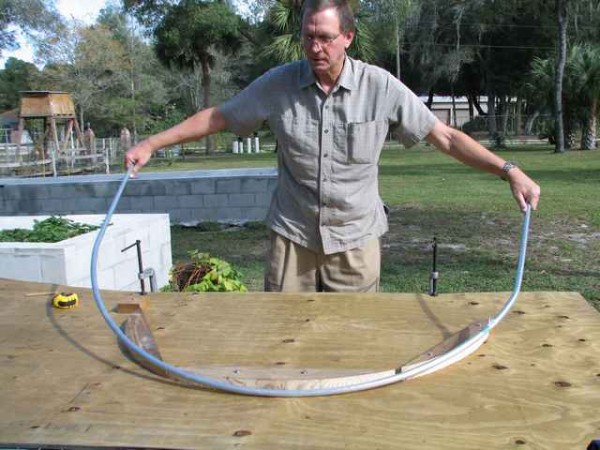
Remove the hoop frame from the jig and adjust if needed.

The finished hoop frame pushed directly into the growing mixture. For taller hoop frames, you may want to insert lengths of PVC pipe over the ends.

Tattler Reusable Canning Lids – Revised Instructions


Tattler reusable canning lids have become a popular item with home canners, so we’re using this post to help spread the word about a change in the instructions. There are plenty of reviews on line about these, so I won’t try to duplicate that here. One thing that I have noticed about many of the reviews that I read was the strong emphasis on following the instructions very carefully. The basic steps are close enough to the way that metal lids are used that it is tempting for experienced canners to just charge ahead without carefully reading and following the instructions. Not a good idea. Canning food is not the time to get careless about following instructions.

Tattler sent an email out today to all of their customers. They are announcing a change in the instructions. Here is what they sent:

Dear Tattler Reusable Canning Lids Customer,

We are e-mailing past customers to inform you of slight changes we made to our instructions in late 2011. We found that many customers were over-tightening the metal screw band prior to processing, which can cause excessive pressure to become trapped in the jar, thus causing potential problems with the seal.

Please refer to the set of new instructions below our company contact information at the bottom of this page, paying particular attention to Step #5 (the only major change we made) and #7 when canning with your reusable canning lids.

Please also note that we have had a price change to include the cost of shipping. If you would like a new brochure with updated pricing please contact us.

If you have any questions, please do not hesitate to contact us at:
877-747-2793 (TOLL FREE)
or
info@reusablecanninglids.com
Thank you and happy canning!!!

Here are two PDF files that have the latest instructions from Tattler:

TATTLER Brochure 2012
TATTLER Instructions Card

Installing The Bison Pump

As we saw in the Bison Water Pump Review, this is a very well designed pump system – for use, installation, and servicing. It comes with a well-written installation manual with drawings and parts list. The Bison pump is made in America – specifically, it is made in Maine – and it shows. The workmanship is excellent and shows an attention to detail that is seldom seen in today’s “Made in China” world. The level of quality is top-notch all the way around. In a word, it is solid.

The objective was to have, in a single well:

  • A conventional electric pump that was immune to the pitting and holes that result from having sulfur in the water. Last year, after only a few years in place, the bottom section of galvanized drop pipe had to be replaced due to at least 13 holes in the pipe.
  • A hand pump to function as a backup in case electricity was not available. The hand pump needed to be very sturdy and able to function for many years without the need of servicing or parts replacement.

This project consisted of pulling the existing submersible electric pump and its galvanized drop pipe and replacing it with the following:

  • At the bottom – the submersible electric pump.
  • Just above the pump – a 5′ section of stainless steel pipe.
  • Above the stainless steel pipe – the Bison in-line pump cylinder.
  • Between the Bison pump and the surface – 1 1/4″ Schedule 120 drop pipe with 3/8″ stainless steel sucker rod.
  • At ground level – the Bison pump head.

This project was done by:

Trentham Well Drilling
2150 W Lime St
Deland, FL 32720
Phone 386-775-3571

The cylinder and pistor that does the pumping

Rick Trentham holding the Bison pump cylinder. The design uses external rods to hold it together, making it a very strong and easy-to-service pump.

The Bison pump head

Underside view of the Bison pump head. (The small white object is a piece of packing material.)

Drop pipe sections are supplied with the sucker rod inside and caps on each end.

Assembling the Bison pump cylinder to the stainless steel pipe that goes down to the submersible electric pump. The blue rope is supplied by Bison Pumps as a safety line.

Assembling the sucker rod to the Bison pump cylinder.

Tightening the drop pipe to the Bison pump cylinder.

The joint between the Bison pump cylinder and the drop pipe below it is taped.

A Tee-tool is used to pull the sucker rod up so that it can be attached to the next section of sucker rod. The wooden paddle tool, supplied by Bison Pumps, holds the assembly in place at the top of the well casing.

Joining two sections of sucker rod and drop pipe together.

Pipe joint compound is applied to each section of drop pipe.

Vise-Grips are used to hold the sucker rod in place while working on it.

The Bison pump head is assembled to the top section of drop pipe.

Wire being fed through Bison pump head.

The finished Bison pump – electric submersible in use, and ready to go as a hand pump if needed.

Bison Water Pump Review

Bison water pump installed in tandem with an electric submersible pump on a 4 inch well

For more information on the Simple Pump, see the July 7, 2013 post.

When we decided to add manual pumping capability to our electric pump well, it came down to two alternatives – the Simple Pump or the Bison Pump. Both are designed for different uses, so one is not necessarily “better” than the other. They are, however, very different. We chose the Bison pump. Before we discuss the Bison pump, let’s look at the Simple pump.

The well and pump company that we use – Trentham Well Drilling in Orange City, Florida – has installed a number of Simple pumps over the years and has had very good results with them. The Simple pump is significantly cheaper than the Bison pump. The Simple pump is also designed to be fairly easy to install by a reasonably skilled homeowner with a helper rather than needing to be installed using professional equipment. The Simple pump might be a good choice if you want to have a complete system stored away in case it is needed in the future. The video instructions on the Simple Pump web site show how to install it. The drop pipe is lightweight plastic and the sucker rod is thin fiberglass that can easily flex to make assembly easy. That is great if you have to install it yourself without the tools of a professional pump company. The same light weight and component flexibility that make it easy to install also mean that it clearly lacks the solid design and construction of the Bison Pump. (See updated information in the Comments following this post.)

Where the Simple Pump is light weight and easy to work with, the Bison Pump is solid and very heavy duty. Everything about it is top quality and it is obvious that they spared no expense in making this the best hand pump available. The workmanship is flawless – welds are smooth and solid; machined parts are finished to a nice polish; moving parts work very smoothly. The material for the main pump body and the pump cylinder is solid stainless steel; the valve at the spout is brass (or bronze); the sucker rod is solid stainless steel; the drop pipe is Schedule 120 PVC. There is nothing that can rust, corrode, or deteriorate. For a hand pump installation that should last a lifetime, the Bison Pump is the hands-down winner. This is the kind of solid made-in-America craftsmanship that this country used to be famous for.

The Bison pump is not cheap (pricing information here). It is a piece of equipment that is built to last a lifetime, made from the best materials available, and designed and built by folks who truly know what they’re doing. There are some things in life where it makes sense to cut corners to save money. Bison does not cut any corners making their pumps, and when it comes to providing your family with a dependable source of clean drinking water, you shouldn’t cut corners either.

In the next post, we’ll cover the installation process for the Bison pump.

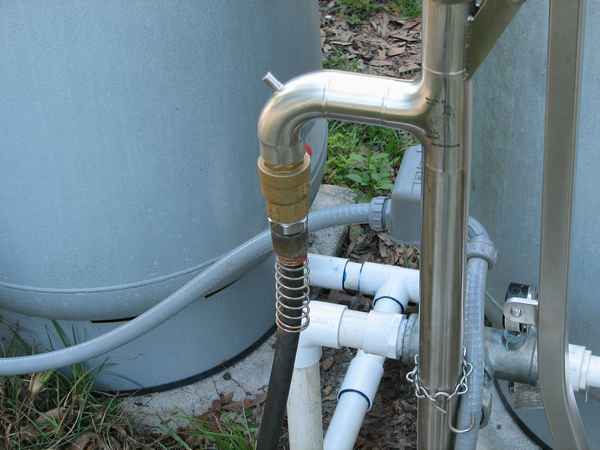
The spout is not just a pipe where the water comes out. It is a solid brass (or maybe bronze) valve with a washered screw-on cap to keep bugs out. Bison didn't miss anything in designing this system.

If water is needed farther away, a standard garden hose fitting screws directly to the spout of the Bison Pump.

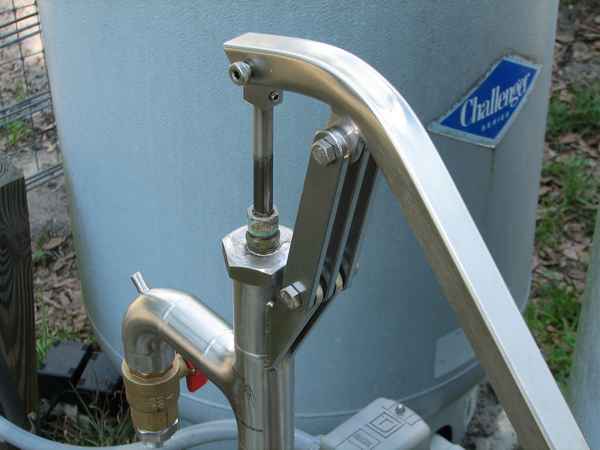
Notice the hinge assembly on the Bison. Solid, machined stainless steel throughout.

The cap through which the rod extends holds the full pressure of the electric pump. It can be tightened to stop water from weeping through it, but I tend to keep it a bit loose.

A bucket hangs nicely from the integrated bucket hook on the spout.

Shown here is the well cap portion of the Bison pump. It is solidly secured to the well casing with four heavy screws. The water outlet to the right feeds into the normal house water system, while the electric cable for the submersible pump feeds straight down to the left of the pump.

A glass of cool fresh water from the Bison pump.

The bison is very smooth and easy to pump and produces a fairly constant flow of water.


This review was based on Bison Deep Well Hand Pump serial number 02214, date 03/26/2012. Installation was done by Trentham Well Drilling, Inc., in Orange City, Florida (phone 386-775-3571).

I understand that there is some federal law that requires a disclaimer for reviews like this, so here it is: I have no financial interest in Bison Pumps, in Trentham Well Drilling, or any pump company, for that matter, nor have I been compensated in any way for anything written here. This entire system was paid for out of my own pocket – every penny of it.

Resilient Communities

The concept of Resilient Communities is one that resonates well with Southern Agrarianism. It is a new term for an old idea – the self-contained village. Some of the large Southern plantations came close to being a resilient community, but not quite. While at first glance, “resilient community” may sound like a fancy phrase for “hippie commune”, it definitely is not the same. Not even close. Take a look at this video about a resilient community in New Zealand to get a better idea of what a resilient community is.

For more information, see the Resilient Communities blog.

Confederate Jasmine – The Sweet Smell of The South

Spring time in The South means many different thing – Azaleas in bloom is certainly one of most visually pleasing parts of Spring, but when it comes to the sense of smell, nothing beats the fragrance of Confederate Jasmine.

I don’t have the vocabulary of one who deals with fragrances, so I will have to resort to saying that it is simply beautiful. We have hundreds of feet of fence covered with Confederate Jasmine, and trees that are close to the fence become covered with it also. In the early morning and late evening when the air is still, the sweet small of Confederate Jasmine seems to be everywhere. It’s just another reason why I am so grateful to call The South my home.

Confederate Jasmine covers the fence surrounding our property.

In the Spring, Confederate Jasmine is covered with these small white flowers that have the sweetest fragrence.

The bees are always at work when the Confederate Jasmine is in bloom.

Farm Dogs

Few things represent the rural agrarian life more than the farm dog. In addition to the companionship that dogs provide, the farm dog really earns his keep. With only one acre, we hardly qualify as living on a farm, yet our dog still has his job and he does it well.

Shiloh is our Shetland Sheepdog (also known as a Sheltie). At 35 pounds, he is a good bit larger than the standards call for, which is why he lost his value as a stud dog and we were able to get him. When pests invade the garden, Shiloh chases them away. An unusual pest for most folks but not uncommon for us is wild peacocks that sometimes get into the garden until Shiloh chases them away. Another job that Shiloh does well is catching chickens that fly over their fence and get into the garden. It’s almost as much fun watching that as it is watching a Border Collie working sheep. He chases the chicken and tries to corner it. The chicken will eventually give up and stop and he just stands over it to keep it from leaving. He never tries to bite or harm the chicken in any way. If we aren’t out there at the time, he will bark to let us know that he needs help. I walk over and pick up the chicken and put it back over the fence. The chickens are usually quite happy to see me after dealing with the dog.

Shiloh as a young puppy, holding a chicken

Deep Planting Tomatoes

One of the first things that anyone learns about transplanting tomatoes is that they should be planted as deep as possible. All the leaves and branches except for those at the very top of the plant should be pinched off and then plant it deep enough so that only those leaves at the tip of the plant are above ground.

I suspect that I’m not the only one who has wondered if the plants ever really catch up in height after being buried that deeply. I decided to find out.

When I plant the garden, in addition to the plants that are spaced out as they should be, I try to always plant some extras so that any that don’t survive or are the victim of bugs or other pests can be quickly replaced. In this case, I planted the spares right next to the primary plants so we can compare them. The primary plants were buried as deep as the plant would allow. The spare plants were planted at the same depth they were at the soil blocks and pots. After a couple of weeks, you can see that the deep buried plants quickly recovered their “lost” height. In addition, the plants had much thicker trunks and are generally more vigorous plants.

The tomato variety shown here is Jaune Flammé (often just referred to as Flammé). These are a French heirloom tomato that produces golf-ball sized tomatoes that are an apricot color when ripe. This is a very prolific indeterminate variety – and clearly the best tasting variety that I know of. They’re too small to make a good sandwich tomato, but for salads and just eating by themselves, they are incredibly delicious. The fact that they don’t turn bright red makes them less attractive to birds, and that’s always a good thing.

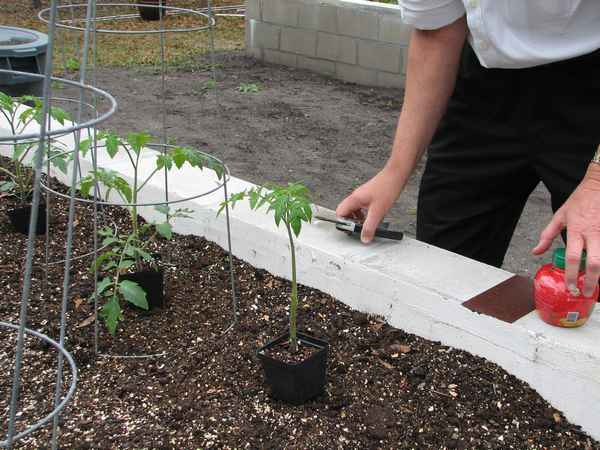
The tomato plants are set out using the tomato cages turned upside down to get the correct spacing.

Tomato plant as-grown, before the pre-planting pruning is done.

After pruning, ready to be planted.

Pruned and ready for planting.

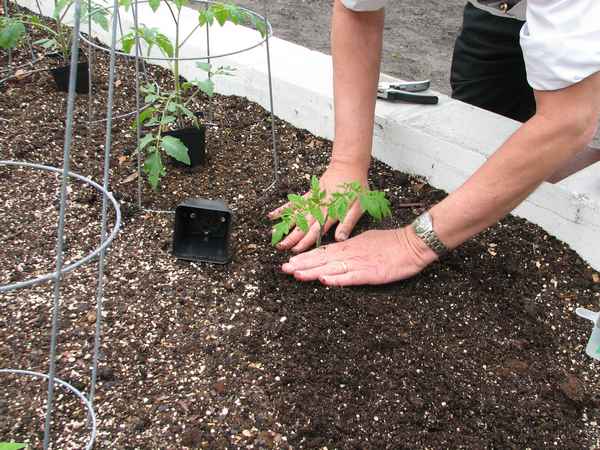
The growing mixture we use is easy to dig by hand, so we don't use the garden trowel very often. The hole is deeper than you might think.

In the past, I have had problems due to missing trace elements. Adding a small amount of tomato-specific fertilizer should eliminate such problems.

Add just a bit of tomato fertilizer to the bottom of the hole.

The roots have been growing around the sides of the pot. It's best not to let them go much longer than this stage.

With a bit of tomato fertilizer in the bottom of the hole, then a small amount of soil mixture to cover it, the plant is added.

The hole is filled and gently tamped.

Finally, a tomato cage is pushed down around the plant, and that's it.


22 Days Later

This is one of the spare plants that was planted at its original depth. The plant to the right (in the cage) was deep planted at the same time this spare was planted.

This is one of the primary plants. When planted, everything except the very top of the plant was pinched off and then it was deep planted so that only the top of the plant was above ground level. A spare plant can be seen to the left - the primary and spare plants have reached the same height despite starting out very differently. Note how thick the plant trunk is on the primary plant.

Tim Manning on Southern Agrarian Writers

Tim Manning

Much of the material we have here at The Southern Agrarian is about the “how-to” aspects of living an agrarian life – raising a garden and chickens and that sort of thing. As important as that is, we need to also understand the philosophical aspects of the Southern Agrarian movement. There are few people today who understand Southern Agrarianism as well as Tim Manning. Mr. Manning regularly publishes his essays on Facebook, and he has granted permission to re-post this one here on The Southern Agrarian.

The following was written by and reprinted with permission from Tim Manning. Mr. Manning is the founder of The Southern Partisan and lives in Kernersville, North Carolina.


I was asked, “Tim…who are your top 3 favs Agrarian writers/titles? Thx”

My reply:

1. Richard M. Weaver,
2. Andrew Nelson Lytle,
3. Donald Davidson,
4. M. E. Bradford,
5. Tom Landess,
6. Cleaneth Brooks, and
7. Marion Montgomery

Sorry, but I could not get it down to three. They are all the older and deceased writers. Among the living:

1. Clyde N. Wilson,
2. James Kibler,
3. Wendell Berry, and
4. Fred Chappell.

I will list the titles a little later.

I also like Lyle H. Lanier, Frank Lawrence Owsley, Robert Penn Warren, John Gould Fletcher and Allen Tate. It is the agrarian writers that turned me on to the Southern culture and heritage, because they gave me a sound perspective for my Christian faith in the time and world that I live in. This is an aspect of understanding missing in most churches today.

Now, Christians are waking-up and thinking that the USA may be moving into Marxism and they think that is a great insight. Most of them do not have a clue about what Marxism is and how it works. Our society, especially the political and academic world, was fully Marxist when I was born in 1945. Now we are quickly becoming a global communist empire. The word society no longer applies. We have lived in a period best described as the “death of western civilization”, meaning a society where Christian beliefs and ethical practices were the norm.

Every college student should have to take at least 2 4-hour semesters of Southern agrarianism to obtain a college degree. Instead, we were forced to read trashy New England writers (yep, a host of nasty yankee writers) that no one of faith would be reading if it were not a requirement of their school and this was in a Southern University, to their great shame. Many Southern institutes, organizations, and societies will not tolerate their members being Southern agrarian in their perspectives. Some Southern churches will not place Christian agrarians in positions of leadership and real spiritual influence.

Worse I had to pay money to study those unskilled trashy writers at a Christian University, because my church was too liberal (affected by agnostic and socialist cultural engineering) to know that these great folks even existed !!! (Insert anger and amazement for the stupid here!) My faith grew more in reading their works than in any class I took in Seminary and grad school.

Not having read this wonderful agrarian literature is why so many Southern people no longer understand the great truths of why the South was right. Many have too narrow a focus on the legal issues which are good and in our favour. If you are not acquainted with these literary giants it is likely that “you ain’t got no book learnin'”, and that is that ! Studying the battles and the great heroes is wonderful and uplifting, but it just does not have the spiritual influence of studying these insightful works which is why there is not a unified Southern movement today.

The League of the South, The Abbeville Institute, The Rockford Institute, and the Stephen Dill Lee Institute understand this. I sent my son each year to these three plus The John Randolph Club, The Mises Institute, The William Gilmore Simms Society, and The Southern Heritage Society.

If you are Southern and spending tens of thousands of dollars sending your children to today’s Marxist public American universities or the semi-Marxism Christian universities, you should make the added investment to build their spiritual understanding by having them read the agrarian writers and attend the above institutes to counteract the poison of modernity. Their lives will be spiritually enriched and will never be the same.

« Older posts Newer posts »